


|
Getting your Trinity Audio player ready...
|

The Government has announced the first major overhaul of New Zealand’s Graduated Driver Licensing System (GDLS) in more than a decade, aimed at making it cheaper and easier for young people to get their driver licence.
The new licensing system will come into effect from 25 January 2027. Until then, existing driver licensing rules will remain in place.
Transport Minister Chris Bishop says the changes are the most significant since 2011, when the minimum learner licence age was lifted from 15 to 16.
“Driver licences are essential for helping people access jobs, education and healthcare,” Bishop says.
“For many young Kiwis, gaining a licence is a rite of passage, but the current system is expensive, outdated and no longer works as well as it should,” Bishop says.
Full licence test to be scrapped
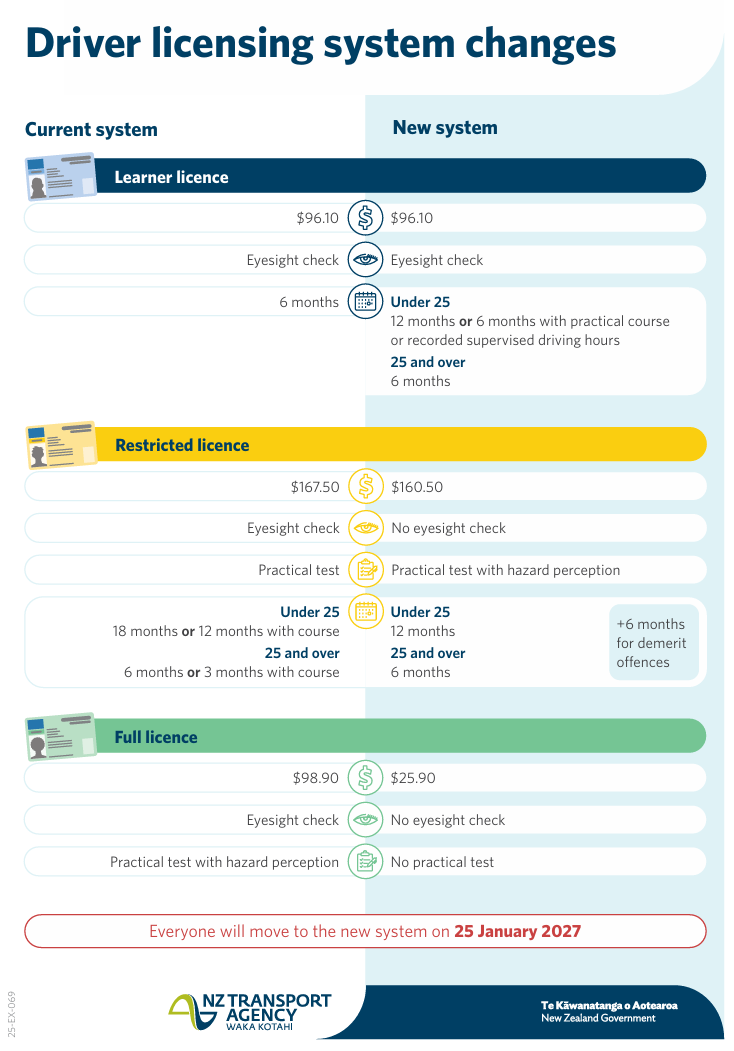
Under the changes, drivers will no longer be required to sit a second practical driving test when progressing from a restricted licence to a full licence, a move the Government says will save both time and money.
New Zealand is currently an international outlier in requiring two practical driving tests for car licences.
“We’re making practical, common-sense improvements to the driver licensing system to ensure it is accessible, efficient and affordable, while keeping road safety front and centre,” Bishop says.
Longer learner and restricted periods for under-25s
The changes include longer mandatory learning periods for younger drivers.
Under the new system:
- Drivers under 25 will be required to spend 12 months on a learner licence, up from six months.
- Under-25s will be able to reduce the learner period back to six months by recording supervised driving hours or completing an approved practical driving course.
- The restricted licence period will be 12 months for under-25s and six months for drivers aged 25 and over, with no option to shorten it through a defensive driving course.
Drivers on a restricted licence who accumulate demerit points will be required to spend an additional six months on their restricted licence.
Licence costs to drop by $80
The Government says removing the second practical test will reduce the overall cost of getting a Class 1 (car) licence by $80.
Under the current system, the total cost is $362.50. Under the new system, it will fall to $282.50.
“Removing the second practical test reduces costs and makes it easier to progress to a full licence, provided drivers demonstrate safe driving behaviour while on their restricted licence,” Bishop says.
Zero-alcohol rule expanded
All learner and restricted drivers, regardless of age, will be subject to a zero-alcohol limit under the changes.
Eyesight tests will also be streamlined, with screenings required only at a person’s first licence application and at licence renewal.
The NZ Transport Agency will gain new powers to monitor and suspend driver training course providers, strengthening oversight of the sector.
Public consultation informed changes
The changes follow public consultation carried out in 2025, which attracted more than 4,100 submissions.
Bishop says feedback led to several refinements, including extending the learner period, imposing additional restricted-licence time for demerit points rather than fully resetting the licence, and retaining the existing demerit suspension thresholds.
“These changes strike the right balance between cost, efficiency and road safety,” he says.
Drivers will still need to demonstrate safe and responsible behaviour, including maintaining a clean demerit record, before progressing to a full licence.
The new licensing system will come into effect from 25 January 2027. Until then, existing driver licensing rules will remain in place.
“Our young people and new drivers deserve a licensing system that is fair, accessible, and keeps them and others safe on the road,” Bishop says.