

|
Getting your Trinity Audio player ready...
|
- By Rose Fuller, Franklin junior journalist
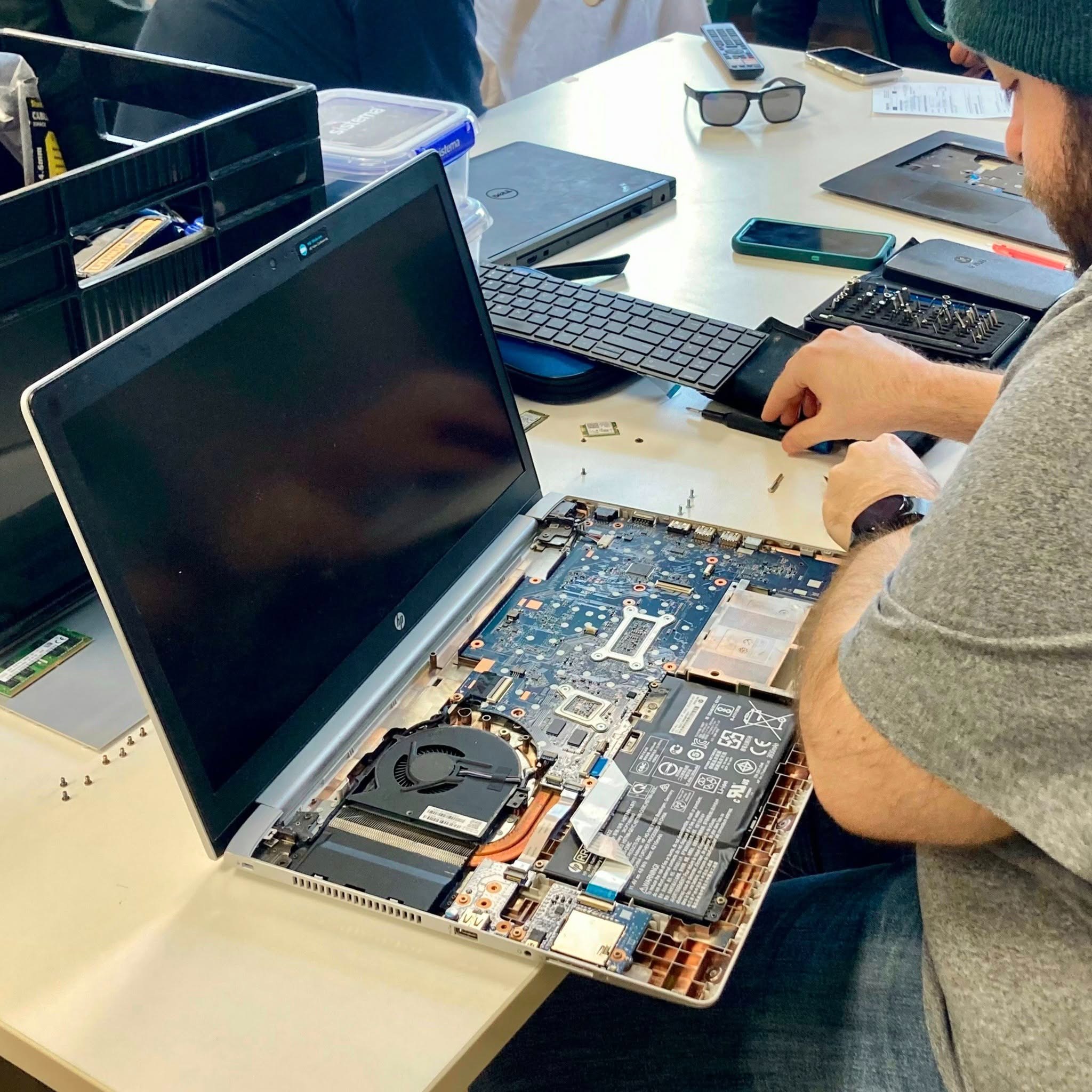
Every month, a quiet, nondescript room above the Pukekohe Library is transformed into a space filled with experts who can fix almost any small household item you have – for free, although a koha is appreciated.
So if you have a toaster that no longer pops, or a necklace with a broken clasp, there’s a good chance you can have them repaired. You can even have your trousers hemmed.
The Pukekohe Repair Cafe is a volunteer organisation dedicated to fixing things to keep items out of landfill and to save people money. It runs on the first Saturday of the month and has been going for more than three years.
I went along on Saturday with some blunt knives from my kitchen. On arrival, I spoke to one of the sewers, Kirsty Sander. Her station was the second most popular in the room.
“I love doing this because I just love helping people and keeping things out of the landfill” Sander said. “That’s our main objective. I feel a lot of things can be easily fixed and go on for a bit longer or even a lot longer.”
Sander has seen a lot of strange items and stories come through the doors, such as the gym bicycle seat she was working on.
“The seat itself is fine. That’s what is so infuriating – there’ll be one small part which is broken, and all the rest is good. That’s when people tend to just chuck it. I think this is a great service for people who can’t afford the places in town. And most often, the job is just a small patch up.”
Next, I made my way to Max McRae, the knife sharpener on the Repair Cafe team. He said his station is also very popular.
“Everyone’s got knives, but very few people know how to properly sharpen them,” McRae says. “There must be millions upon millions of knives in New Zealand, and if you think of it as maybe 20 per household, that’s a lot of knives.”
He says he volunteers his time because every knife is a new challenge for him.
“And, it’s enormously satisfying to give someone an implement they didn’t realise was incredibly blunt, and not up to par, then fix.
“A few months ago, I had to sharpen a combat knife called a Fairburn Sykes commando knife, which was used during World War 2 for slitting the enemy’s throats. The tip had been broken off, and I had to re-establish it.”
After a few minutes, McRae handed me back my newly razor-sharp knives, which now slice through a tomato like butter, and I can’t help but wonder (and hope) that this is the new purpose of the commando knife.
Before leaving the Repair Cafe, I spoke to the manager, Jim Ball. He’s the general fix-it guy.
“We’ve got leather workers, electricians, seamstresses, clock repairs, general repairs, bike repairs and knife sharpening,” Ball said.
As well as the challenge of the repair, he enjoys the good stories too.
“A person once brought in a clock to be fixed, and the outside was broken. We fixed that, but before he left, he asked me not to restart it. I wondered why, but didn’t touch it.
“When he came back, I asked him, ‘Why didn’t you want us to restart the clock?’ and he said, ‘Because the clock was my grandfather’s and when he died, the clock stopped’.”
Every month, the Repair Cafe sees an average of 40 people through the door, and Ball says that’s the best fix of all.
“Over a day, we stop roughly $2000 worth of stuff from going to the landfill, and it’s just such a rewarding job to do. To see a customer smile when you hand over the finished product makes our time and effort worthwhile.”