

|
Getting your Trinity Audio player ready...
|

A documentary following the police search for Tom Phillips and his three children is being developed for global release, but repeated redactions in an access agreement released under the Official Information Act obscure which streaming platform is involved and raise questions about transparency, commercial scope and how police have described the arrangement.
A documentary following the police search for Tom Phillips and his children is being developed with global streaming in mind, but Official Information Act (OIA) responses to the Franklin Times have left key details about its intended distribution obscured.
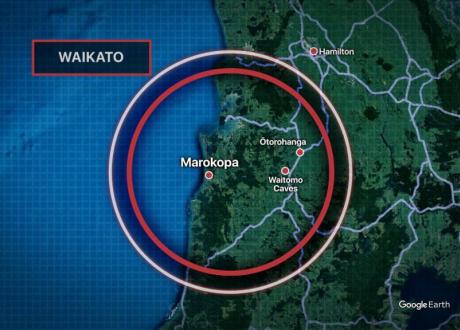
The documentary, with the working title The Marokopa Project, is being produced under a formal access agreement relating to Operation Curly, the police investigation launched after Phillips disappeared with his three children from Marokopa in December 2021.
The Operation Curly Access Agreement, signed in March 2025, allows production companies NHNZ Worldwide and London-based Grain Media exclusive access to aspects of the police investigation, including briefings, operations and selected evidential material, subject to extensive controls retained by police.
However, portions of the agreement released under the OIA are redacted – those which appear to involve the identity of the global streaming platform intended to broadcast the documentary.
Who are Grain Media?

Grain Media is an independent UK documentary production company founded by Oscar-winning filmmaker Orlando von Einsiedel, with a long track record producing documentaries for global streaming platforms, particularly Netflix. Its films include Virunga (2014, Netflix), The White Helmets (2016, Netflix), Evelyn (2018, Netflix), Learning to Skateboard in a Warzone (If You’re a Girl) (2019, Netflix), Convergence: Courage in a Crisis (2021, Netflix), Heart of Invictus (2023, Netflix), and Scouts Honor: The Secret Files of the Boy Scouts of America (2023, Netflix).
Multiple redactions linked to the same unnamed platform
The unnamed platform appears repeatedly throughout the agreement, with five separate references redacted.
These include a clause stating the film “is to be broadcast by [redacted]”, the definition of “release date”, which is described as the date the documentary becomes available for public viewing on the redacted platform “anywhere in the world”, and a clause allowing police, subject to the agreement of the same unnamed entity, to promote the documentary on their own digital channels.
A further clause governs what happens if the producers enter into any agreement with any person other than the redacted platform for the use, sale, replay or broadcast of the documentary or any material derived from it, either in New Zealand or overseas. In those circumstances, police approval is required before any such use proceeds.
Even the execution page of the contract includes a redaction relating to Grain Media’s signature.
Taken together, the repeated references indicate a central, primary distribution platform whose identity has been withheld on commercial sensitivity grounds.
Global distribution language
While the name of the platform is redacted, the agreement is explicit about the documentary’s intended reach.
Even police have to have the permission of the yet unnamed platform to be able to promote the documentary.
“Subject to the agreement of [redacted] Police may at Police’s discretion choose to promote the Documentary on their digital channels,” the agreement states.
The “release date” is defined as the date on which the documentary becomes available for public viewing “anywhere in the world”, although not before the recovery of the children and the final resolution of any applicable court proceedings.
The Final Proposal attached to the agreement describes the documentary as a feature-length film of between 90 minutes and two hours, envisaged to be broadcast in approximately 2027.
That language, combined with the involvement of Grain Media – a UK production company with a long history of producing documentaries for global streaming platforms including Netflix, indicates the project was pitched for an international audience rather than a domestic New Zealand release alone.
The agreement also makes clear the documentary is not necessarily confined to a single platform.
Under the contract, the producers may seek to sell, replay or broadcast the documentary beyond the redacted primary platform, provided police approval is obtained and court orders or sub-judice considerations are not breached.
That provision leaves scope for additional commercial value to be generated from the documentary after its initial release, derived from a case rooted in what has been a harrowing ordeal for the families involved.
Police OIA response names only one producer
In response to OIA requests lodged by the Franklin Times on September 11, 2025, police stated they did not have an agreement with any party other than NHNZ Worldwide in relation to the documentary.
Asked whether the documentary would be a product for the national broadcaster to stream, the OIA revealed, “Police does not have an agreement with TVNZ or any party other than NHNZ Worldwide in relation to the documentary,” the response said.
That statement contrasts with the wording of the access agreement itself, which explicitly names three parties: New Zealand Police, NHNZ Worldwide and Grain Media Ltd. The agreement repeatedly refers to NHNZ Worldwide and Grain Media collectively as “the Producer(s)”, and both companies signed the contract alongside police.
It remains unclear whether police were using a narrower internal definition when responding to the OIA, or whether the response did not fully reflect the contractual arrangements set out in the document they released.
Family contact, Court orders and consent
Under the agreement, responsibility for contacting and managing relationships with members of the Phillips family sits with the producers rather than police.
The Franklin Times understands, after speaking with representatives of both the maternal and paternal families, that no contact has yet been made with them by the producers.
In addition, wide-ranging suppression orders issued by Hamilton Family Court Judge Garry Collin place severe restrictions on what can be published about the Phillips children.
The orders prohibit publishing or communicating any information about the children, publishing images or footage beyond those that existed before December 9, 2021, and publishing any documentary, film or book that refers to the children.
Participants who do appear in the documentary are required to sign a broad consent form granting the producers worldwide, perpetual rights to use, edit and exploit footage, waiving copyright claims and agreeing to confidentiality provisions.
It remains to be seen if the documentary will even proceed.
Read more: The Marokopa Project: The Tom Phillips documentary that may never air
Why the redactions matter
The identity of the proposed streaming platform has been withheld under the Official Information Act on the grounds of protecting commercial interests.
For the Franklin Times, which requested the documents, the issue is not whether police should have participated in a documentary, but whether official responses accurately reflect the agreements entered into, particularly where those agreements involve exclusive access to a major criminal investigation, global distribution, and the potential for further commercial exploitation.
In addition, journalists covering the aftermath of the events of September 8 and prior were not granted ‘exclusive’ access and some media requests covering the Phillips’ case over almost four years were difficult to obtain.
Further clarification is now being sought around why the streaming platform’s identity has been so extensively redacted, and why Grain Media was not referenced in police descriptions of the agreement despite being a named contracting party.