

|
Getting your Trinity Audio player ready...
|

Finance minister Nicola Willis has revealed the delivery of Budget Day to be May 28 and has been quoted saying that while Kiwis are still finding it tough economically, things “will get better this year.”
It comes as the inflation rate sits outside the Reserve Bank of New Zealand’s (RBNZ) target band of 1 to 3% – at 3.1%.
While Willis says she is optimistic about the year ahead, economists say the recovery is likely to be uneven, with businesses better placed to benefit than households in the short term.
CEO of and Principal Economist at Infometrics, Brad Olsen says, the rising cost of essentials is driving inflation and despite a lift in business activity, the employment sector is still struggling.
“A stream of end-of-year data points to a more upbeat economic outlook for 2026, at least on the surface,” he says.

“Manufacturing and services activity lifted toward the end of last year, which Olsen says is encouraging after a prolonged slowdown. Job advertisements have also risen slightly, although they remain low compared with historical levels.”
Despite that lift, Olsen says the job market remains extremely tough for many workers. Infometrics’ analysis of SEEK data shows that while job ads in November 2025 were still 22 per cent lower than in November 2019, the number of applications per job ad was 243 per cent higher.
“In practical terms, there are now about three-and-a-half times more people applying for every job than there were before the pandemic,” Olsen says, meaning competition for roles remains intense.
Business confidence improved
“The New Zealand Institute of Economic Research Quarterly Survey of Business Opinion shows the strongest levels of forward-looking confidence since early 2014, suggesting firms are increasingly expecting conditions to improve,” Olsen says.
However, he cautions that not everything is moving in the right direction. Inflation has risen back above the top of the Reserve Bank’s target band, and household spending at the end of last year was more subdued than expected.
Why are essential living costs still so high?
Olsen says the main reason households are still under pressure is that essential costs are rising faster than discretionary spending.
“The increase in essential costs has been driven by sharp rises in electricity prices, up 12 per cent year-on-year, gas prices, up 16 per cent, as well as higher insurance premiums and rising meat and dairy prices.
“Energy prices have climbed as Transpower and local lines companies face higher costs, with the Commerce Commission allowing revenue limits to increase as those costs rise.”
Olsen says higher labour and materials costs are part of the picture, but so too is the growing investment required to build a more resilient electricity network and expand generation and transmission capacity.
“Insurance prices have been pushed higher by continued large claims and rising reinsurance costs overseas, following multiple major natural disasters and extreme weather events that have hit insurers globally.”
Olsen says food prices have been shaped by global supply and demand pressures. Olsen says dairy prices surged last year as demand outstripped supply, driving rapid increases in butter prices. As more dairy supply came online toward the end of 2025, prices have started to ease slightly.
“Meat prices, however, remain elevated. Strong global demand, combined with limited supply, particularly lower beef stock numbers in the United States, has continued to push prices higher as buyers compete for a constrained supply.”

The result, Olsen says, is that even as some parts of the economy show signs of improvement, many households continue to feel squeezed because the biggest increases are hitting costs that cannot be avoided.
“You can usually delay buying a couch or a television, but you can’t decide that electricity or rent is optional,” Olsen says. “Those costs are inescapable.”
Infometrics’ analysis shows essentials inflation accelerated to 3.8 per cent year-on-year in the December 2025 quarter, the fastest pace since mid-2024. By comparison, discretionary inflation remained more subdued at 1.8 per cent.
Over the longer term, essentials inflation has consistently been both higher and more volatile than discretionary inflation. Over the past 20 years, essentials inflation has averaged 3.2 per cent, compared with 1.8 per cent for discretionary items.
“Those figures highlight the challenge households currently face. While discretionary price pressures are close to long-run averages, essentials inflation remains above its historical norm and is still accelerating,” Olsen says.
What counts as essential?
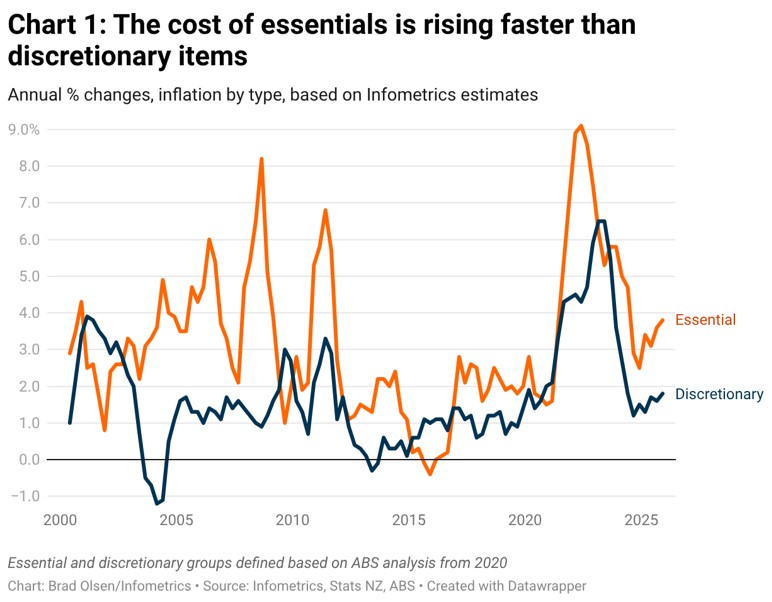
To define essential and discretionary spending, Infometrics drew on analysis by the Australian Bureau of Statistics (ABS), which classifies costs as “non-discretionary” or “discretionary”.
As the ABS notes, deciding whether a good or service meets a basic need can be subjective and may differ between households. However, given the similarities between the New Zealand and Australian Consumer Price Index (CPI baskets), Infometrics aligned its analysis with the ABS definitions at the CPI component level, covering around 90 components.
Essential items are those required to meet basic needs, maintain current living arrangements, or fulfil legal obligations. Discretionary items are more optional purchases, for example, vegetables are considered essential, while confectionery is discretionary.
Inflation explained:
The Reserve Bank of New Zealand (RBNZ) explains that “Inflation occurs when prices of a range of goods and services rise on average. It means that money’s buying power is decreasing, although some wages may rise faster than inflation.
“In general, inflation occurs when demand for goods and services in the economy is outpacing supply. This leads to widespread shortages of labour and materials. For example, when lots of people want to build a house, it becomes hard to source materials and construction workers, so building costs increase.
“Businesses can charge higher prices for the same goods or services, as long as consumers are willing to pay more. Inflation can also be caused by a rise in the price of imports, such as oil.”
RBNZ says to keep inflation low and stable, “the Government has set us an inflation target of keeping inflation between 1% and 3% over the medium term, with a focus on keeping future inflation near the 2% midpoint.
“Low inflation is the best contribution we can make to boosting the economic wellbeing and prosperity for all New Zealanders.
“If prices are stable, households and businesses can better plan their spending and investment. Low and stable inflation helps the economy to grow.”
The last inflation update from RBNZ was on January 23, it will post the next update on April 21.